Guide
Run two or three different checkers
Main keyword: compare AI checkers. This is an educational guide, not a hands-on test and not a paid ranking. Sources were checked on 2026-11-18 unless a citation says otherwise.
Pick official tools that can actually run the passage
The checkers we point to are official websites that, on the pages we opened on 18 November 2026, offered a free or instant check of some kind. That might be a no-sign-up paste box (Scribbr), a free official plan (ZeroGPT’s pricing page describes a plan as “$ 0 forever”), a published character cap (Sapling’s free check of 2,000 characters; the GPTZero homepage field we opened showed 10,000 characters), or daily or new-user credits (Pangram’s “20 free credits daily”; Copyleaks’ limited free credits for new users).
You do not need all eight. Choose two or three whose official limits fit the text. If one tool cannot take the whole passage, either split it only as the official page suggests, or record that you could not run a complete check on that tool and still use the others.
Keep the input the same
Compare like with like. Paste the same prepared passage, in the same language, without silently editing it between tools to “improve” a score. If a tool rejects the text because it is under a published minimum — QuillBot’s official 80-word request, for example — write that down instead of padding the text just to obtain a number.
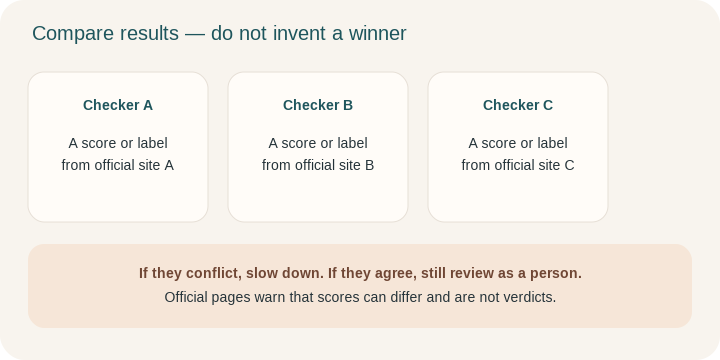
Record, for each official site: the URL you used, the date, any published limit that applied, and the result in the vendor’s own wording (a percentage, a label such as “mixed,” or a short official explanation). Do not convert everything into a homemade average. See comparing conflicting results.
What you are not doing
You are not ranking the tools, and you are not running a scientific study. Vendor accuracy claims on official marketing pages are still claims. You are collecting two or three official signals so that a person can review them alongside process evidence and policy.
If a site also markets a “humanizer,” as ZeroGPT’s official homepage does, do not use this workflow as a way to hide undisclosed AI use. The goal is a fair, documented check, not a lower number.
Frequently asked questions
Is a paid checker automatically more trustworthy than a free one?
Not on the evidence this site can cite. Official free and paid pages alike warn that tools can be wrong. We have not hands-on tested either kind.
What if I only have time for one checker?
Then treat that single official result as an especially thin signal, say so in your notes, and lean harder on human review. Official pages already say a detector should not stand alone.
Sources checked for this guide
- Scribbr official AI Detector page. Checked on 2026-11-18.
- ZeroGPT official pricing page. Checked on 2026-11-18.
- Sapling official AI detector page. Checked on 2026-11-18.
- GPTZero official homepage. Checked on 2026-11-18.
- Pangram official homepage. Checked on 2026-11-18.
- Copyleaks official AI Detector page. Checked on 2026-11-18.
- QuillBot official AI Detector page. Checked on 2026-11-18.
- ZeroGPT official homepage. Checked on 2026-11-18.
Related guides
- Prepare the text — Short, isolated, or heavily edited text is a weaker signal. Prepare the passage and read official limits before you paste.
- What to do with conflicting results — If official checkers disagree, slow down. If they agree, you still do not have proof. Document what each official site said.
- Documenting a check — A short written record keeps a check fair and honest: what you ran, what the official sites said, and that a score was not used alone.
All guides · All sources · How we review · Tools we point to