Editorial status: AI-drafted text — pending human fact-check. Product facts that name a vendor were checked on official websites on 2026-11-18. We have not done hands-on testing unless a listing’s testing notes say otherwise. This notice will be removed only after a person has reviewed the wording.
Google’s official guidance is about helpful, accurate, people-first content — not about a detector percentage. Use official checkers as an internal pass, then fact-check.
Main keyword: AI detector for SEO content. This is educational guidance, not legal, academic-conduct or employment advice.
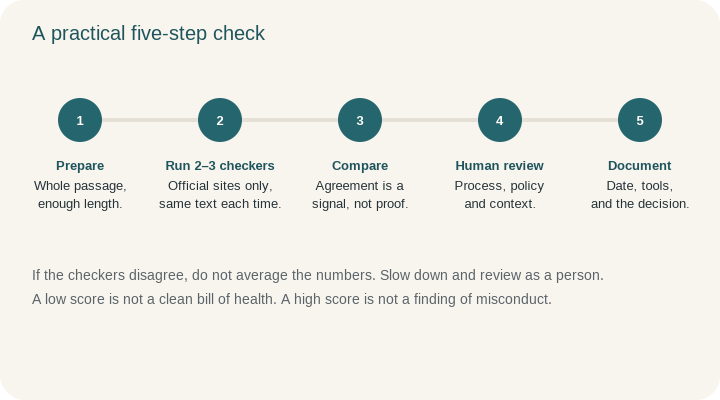
A detector score is not a Search ranking report. Original diagram.
What official Google guidance actually asks
Google’s official page “Google Search’s guidance on using generative AI content on your website,” last updated 1 October 2026 and opened on 18 November 2026, says generative AI can help with research and structure, but that using such tools “to generate many pages without adding value for users may violate Google’s spam policy on scaled content abuse.” It tells publishers to focus on accuracy, quality and relevance, and to manually fact-check AI-generated content, including metadata, because models “don’t retrieve facts, but predict a likely sequence of words.”
The same official page says sharing how content was created can give readers context. It does not tell you to attach a detector score to every URL, and it does not treat any vendor’s percentage as a ranking system.
Where a checker still fits
If you manage freelancers or agencies, you can run the shared two- or three-checker workflow on delivered copy as an internal quality flag, then edit and fact-check. Watch official length caps: a 2,000-character free check is not a review of a long article. Do not “optimise” a page only to lower a detector score, and do not use a humanizer to hide mass-generated content. Official QuillBot wording is to disclose AI use rather than revising only to change a score.
Guides in this hub
How to check if text is AI-written — Do not paste once and treat one score as a verdict. Prepare the passage, run two or three official checkers, compare, then review as a person.
Prepare the text — Short, isolated, or heavily edited text is a weaker signal. Prepare the passage and read official limits before you paste.
Run two or three different checkers — Use official websites, the same prepared text, and two or three tools. Record each result in the vendor’s own wording.
Documenting a check — A short written record keeps a check fair and honest: what you ran, what the official sites said, and that a score was not used alone.
Tools this hub points to
Good for a free official homepage check — with the caveat that the same site also markets an AI Humanizer
An official site that advertises a free plan at $0 forever and a paste-in checker. Official accuracy figures are vendor claims. The same site also markets an AI Humanizer, which this workflow does not recommend for hiding AI use.
Official free check of the first 2,000 characters, $0/month on the official pricing page. Official warning: no current detector, including Sapling’s, should be used as a standalone check.
Official homepage advertises 20 free credits daily for text, image and video checks. Published accuracy figures are vendor claims, not this site’s tests.
Official page advertises a free AI checker, up to 25,000 characters for free, and limited free credits for new accounts. Official 99% and .03% figures are vendor claims. The official page also notes some Grammarly features can be flagged.
This site stores your cookie choice in your browser (localStorage) so the banner does not keep reappearing. This site uses Google AdSense. Google and its partners may use cookies to serve ads, including personalised ads, based on your visits to this and other sites. You can opt out at Google Ads Settings and www.aboutads.info. Read the Privacy Policy. Datenschutzhinweis: Ihre Wahl wird nur auf diesem Gerät gespeichert.