Guide
Handling a possible false positive
Main keyword: AI detector false positive workflow. This is an educational guide, not a hands-on test and not a paid ranking. Sources were checked on 2026-11-18 unless a citation says otherwise.
Official pages already say this error happens
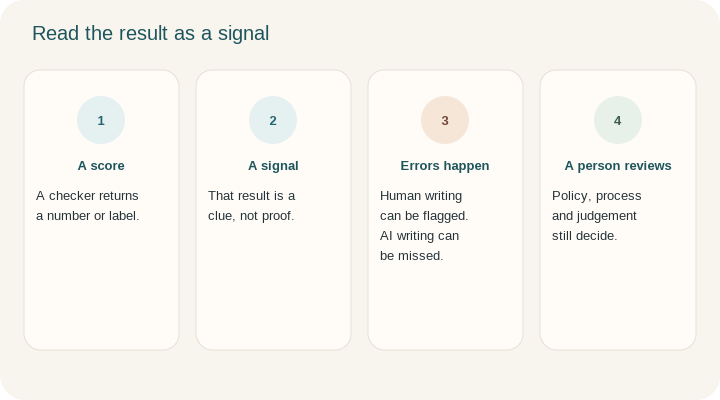
A false positive, in this workflow, means a checker treats human-written text as AI-generated. Turnitin’s official blog uses that definition for fully human-written text and says the false-positive rate “is not zero,” even while publishing a vendor claim of a “less than 1%” rate. GPTZero’s official FAQ says there are always edge cases in both directions. Sapling’s official detector page says false positives and false negatives will occur, and that shorter, more general, or more essay-like text is more likely to produce a false positive. Grammarly’s official user guide says the percentage is not an objective source of truth.
OpenAI’s official page on its withdrawn 2023 classifier said human-written text can be “incorrectly but confidently labeled as AI-written,” and that short or very predictable text is especially hard to judge. Those official warnings are why this step exists.
Risk areas to look at, without over-claiming
Short text, formal or formulaic prose, and text that has been through AI editing tools are all officially documented risk areas, as the prepare the text step explains. Grammarly, Originality.ai and Copyleaks official pages all discuss editing or rewrite features that can affect a flag.
Non-native English writing is another documented concern. Liang, Yuksekgönül, Mao, Wu and Zou, in the arXiv abstract we opened on 18 November 2026 (arXiv:2304.02819), report that the detectors in their study “consistently misclassify non-native English writing samples as AI-generated, whereas native writing samples are accurately identified.” That paper is time-stamped and does not automatically measure a particular 2026 commercial tool, but it is a reason to take this risk seriously and to look at more than a score. Some vendors, including GPTZero on official pages, later publish their own claims about reduced ESL false positives; those are vendor claims, not an independent re-run of that study by this site.
What to do in the workflow
Keep the official results, including any conflicting ones. Do not delete a flag because it is inconvenient, and do not treat it as proof because it is convenient. Look at process evidence, policy, and usual work. If you are the person who has been flagged, offer drafts and a calm account of how the work was produced; if you used AI, say so. QuillBot’s official page says to disclose AI use rather than revising only to change a score.
If you are the reviewer, Turnitin’s official tips are practical: plan for false positives, assume positive intent when evidence is unclear, and be open that a false positive may occur. A second official checker can show disagreement — Grammarly’s official guide says scores may differ — but it will not usually “clear” or “confirm” a case by itself. For students and teachers, the audience workflows go into more detail. This site is not legal advice and cannot hear a case.
Frequently asked questions
Does a second low official score prove the first flag was a false positive?
No. It is useful context, especially because official tools can disagree, but it is not a counter-proof. Look at process evidence as well.
Should I use a humanizer to lower a score?
No. This workflow does not recommend hiding undisclosed AI use or changing a score for its own sake. Official QuillBot wording is to disclose AI use rather than revising only to change a score.
Sources checked for this guide
- Turnitin, “Understanding false positives in Turnitin AI detection”. Checked on 2026-11-18.
- GPTZero official FAQ. Checked on 2026-11-18.
- Sapling official AI detector page. Checked on 2026-11-18.
- Grammarly Support, “AI Detector user guide”. Checked on 2026-11-18.
- OpenAI, “New AI classifier for indicating AI-written text” (31 January 2023; withdrawn 20 July 2023). Checked on 2026-11-18.
- Liang et al., “GPT detectors are biased against non-native English writers,” arXiv:2304.02819 — We opened the arXiv abstract on 18 November 2026. The abstract reports that the detectors in the study consistently misclassified non-native English writing samples as AI-generated, while native writing samples were accurately identified.. Checked on 2026-11-18.
- QuillBot official AI Detector page. Checked on 2026-11-18.
- Originality.ai official homepage. Checked on 2026-11-18.
- Copyleaks official AI Detector page. Checked on 2026-11-18.
- GPTZero official homepage. Checked on 2026-11-18.
Related guides
- A human review checklist — After the official scores, look at policy, drafts, usual work and a chance to respond. Then write down the decision.
- What to do with conflicting results — If official checkers disagree, slow down. If they agree, you still do not have proof. Document what each official site said.
- Prepare the text — Short, isolated, or heavily edited text is a weaker signal. Prepare the passage and read official limits before you paste.
All guides · All sources · How we review · Tools we point to