Guide
Documenting a check
Main keyword: how to document an AI detection check. This is an educational guide, not a hands-on test and not a paid ranking. Sources were checked on 2026-11-18 unless a citation says otherwise.
Why a record matters
High-stakes settings — grading, publishing, hiring — go badly when a score exists in someone’s memory but not in a file. Official sources cited throughout this site say a detector result should not stand alone. A short record makes that habit visible: you can show which official checkers you used, whether they agreed, what process evidence you looked at, and how the writer was able to respond.
Jisc’s official principles include contestability: people should have a way to contest an AI system’s output when it affects their outcomes. A written record is part of making that possible. The University of Missouri’s official page says a detection report should not be the sole evidence in a misconduct process; a file that contains only a screenshot of a percentage is the habit that page is warning against.
What to write down
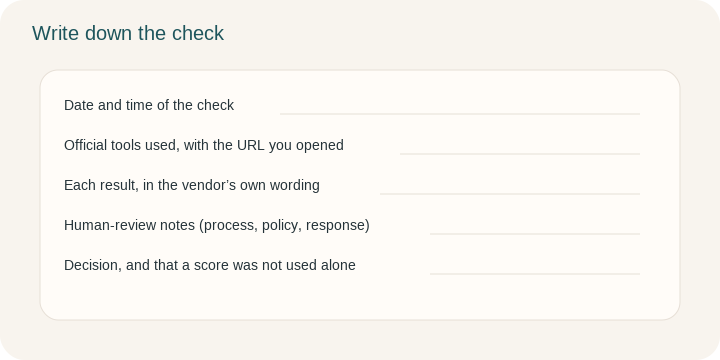
Date and time. A short description of the passage (and its length). The official tool names and the exact URLs you opened. Any published limit that applied (for example a 2,000-character free cap). Each official result in the vendor’s wording, not a homemade average. Whether the results agreed or conflicted. Human-review notes: policy, drafts or version history, usual work, and any response from the writer. The decision, and a sentence that the score was not used as the only evidence.
You can print the checklist and fill the same fields by hand. Do not paste sensitive personal data into a public page, and do not upload student or applicant work to this site — this domain does not host a detector.
What not to write
Do not write “the AI detector proved this was ChatGPT.” Official pages do not give you that certainty. Do not hide a conflicting official result. Do not record a vendor marketing claim (“99% accurate”) as if it were your test of this specific passage.
Keep the record as private as the work itself. Follow your school’s or employer’s retention and privacy rules.
Frequently asked questions
Do I need to store the full text I pasted?
Only if your policy says you should, and only in a place that is allowed to hold that work. Official vendor sites may also store what you paste — read their privacy pages.
Is a screenshot of a score enough?
It is not enough as the only item in a high-stakes file, on the official and institutional guidance cited here. Add the other official results, the limits that applied, and your human-review notes.
Sources checked for this guide
- Jisc, “Principles for the use of AI in FE colleges”. Checked on 2026-11-18.
- University of Missouri, “AI Detection Tools” (AI @ Mizzou). Checked on 2026-11-18.
- QuillBot official AI Detector page. Checked on 2026-11-18.
- Turnitin, “Understanding false positives in Turnitin AI detection”. Checked on 2026-11-18.
- Sapling official AI detector page. Checked on 2026-11-18.
Related guides
- A human review checklist — After the official scores, look at policy, drafts, usual work and a chance to respond. Then write down the decision.
- How to check if text is AI-written — Do not paste once and treat one score as a verdict. Prepare the passage, run two or three official checkers, compare, then review as a person.
All guides · All sources · How we review · Tools we point to