Guide
What to do with conflicting results
Main keyword: conflicting AI detector results. This is an educational guide, not a hands-on test and not a paid ranking. Sources were checked on 2026-11-18 unless a citation says otherwise.
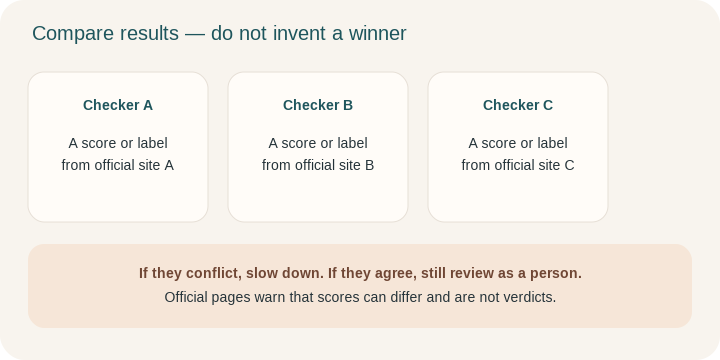
Official tools can disagree
Grammarly’s official user guide, checked on 18 November 2026, says its scores “may differ from those of other solutions like Turnitin, GPTZero, Copyleaks, and others,” and that you should not view a Grammarly score as a clear indication that a professor will see the same score on a preferred detector. That official warning is the foundation of this step: conflicting official results are expected enough to plan for.
A conflict can also appear for reasons that are not “one tool is right.” Official limits differ (a 2,000-character slice versus a longer paste). Official pages warn that AI editing tools can change a score. One vendor may offer a “mixed” or “AI-refined” label while another returns only a percentage. Record those differences instead of flattening them.
If the results conflict
Do not average the percentages into a homemade “true score.” A 20% and an 80% do not become a reliable 50%. Treat the disagreement as a reason to slow down: go back to the human review checklist, look at drafts and process, and, if the stakes are high, give the writer a chance to respond. Turnitin’s official blog, written for instructors, asks people to assume positive intent when evidence is unclear and to be open that a false positive may occur.
Write down each official result in the vendor’s wording, plus any published limit that applied. The decision flow puts this branch in one picture: conflict still ends in a human review, not in a winner-takes-all score.
If the results roughly agree
Agreement is a stronger signal than a single official result, and it is still not proof. Official pages already say that tools can flag human writing and can miss AI writing. OpenAI’s withdrawn classifier, in the company’s own evaluation, missed a large share of AI text and still falsely labelled some human text. GPTZero’s official FAQ says edge cases exist in both directions. Jisc’s official principles say detection tools “cannot conclusively prove text was written by AI, generate false positives, and are easy to defeat.”
A cluster of low scores is not a clean bill of health. A cluster of high scores is not a finding of misconduct or a hiring decision. Both should move you to a documented human review, not to an automatic conclusion.
Frequently asked questions
Should I keep running more tools until they agree?
No. Two or three official checkers is the method. Adding tools only to hunt for a convenient number is not a fair check.
If two tools are high and one is low, can I ignore the low one?
No. Record all official results, including the one that does not fit, and review the work as a person.
Sources checked for this guide
- Grammarly Support, “AI Detector user guide”. Checked on 2026-11-18.
- Turnitin, “Understanding false positives in Turnitin AI detection”. Checked on 2026-11-18.
- OpenAI, “New AI classifier for indicating AI-written text” (31 January 2023; withdrawn 20 July 2023). Checked on 2026-11-18.
- GPTZero official FAQ. Checked on 2026-11-18.
- Jisc, “Principles for the use of AI in FE colleges”. Checked on 2026-11-18.
Related guides
- Read the results as signals, not as proof — A percentage or label is an estimate from a model. Official pages say it is not a verdict, not objective truth, and not a decision on its own.
- A human review checklist — After the official scores, look at policy, drafts, usual work and a chance to respond. Then write down the decision.
- Documenting a check — A short written record keeps a check fair and honest: what you ran, what the official sites said, and that a score was not used alone.
All guides · All sources · How we review · Tools we point to