Guide
How to check if text is AI-written
Main keyword: how to check if text is AI-written. This is an educational guide, not a hands-on test and not a paid ranking. Sources were checked on 2026-11-18 unless a citation says otherwise.
The short version
This is a practical method, not a promise that you can prove authorship. Official pages we opened on 18 November 2026 say, in various words, that a detector score is not a verdict. QuillBot’s official page says “scores are signals, not verdicts” and tells you never to make an academic or employment decision on a score alone. GPTZero’s official homepage says results “should not be used to punish or as the final verdict.” Sapling’s official detector page says no current detector, including theirs, “should be used as a standalone check.” OpenAI, writing about its withdrawn 2023 classifier, said the tool “should not be used as a primary decision-making tool” and that “it is impossible to reliably detect all AI-written text.”
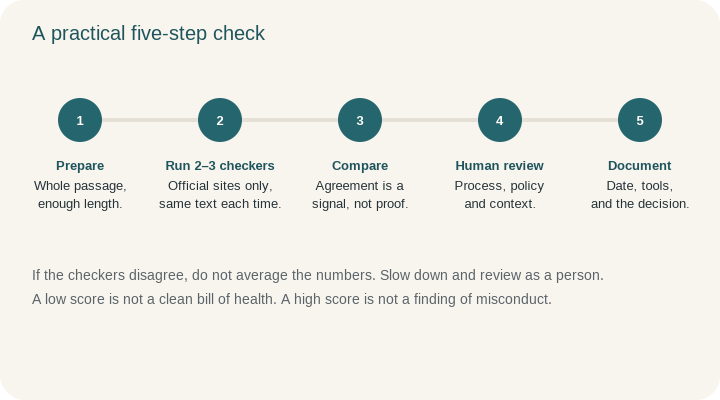
So the workflow on this site is: prepare the text, run two or three official checkers, compare what they say, read the results as signals, do a human review, and write down what you did. The rest of the pages unpack each step. If you only want a worksheet, use the printable checklist and the decision flow.
Why two or three checkers, not one
A single official tool can be useful, but it is a weak basis for a high-stakes decision. Grammarly’s official user guide says its scores “may differ from those of other solutions like Turnitin, GPTZero, Copyleaks, and others,” and that you should not treat a Grammarly score as a clear indication that a professor will see the same result. If official tools can diverge, one number is not a finding.
Running two or three official checkers on the same prepared passage gives you a comparison: they roughly agree, they conflict, or one of them could not run because of a published length or credit limit. None of those outcomes is proof. Agreement is a stronger signal; conflict is a reason to slow down. The compare results step explains what to do in each case.
What this site will not do for you
This domain does not host a paste-in detector. Visit buttons go to official vendor websites. We have not hands-on tested the tools, and we do not invent accuracy figures. Vendor claims such as “99%” or “less than 1% false positives” are labelled as claims when we mention them at all.
This site also will not help you hide undisclosed AI use. QuillBot’s official page says that if AI contributed to your work, you should disclose it rather than revising only to change a score. Follow the policy that actually applies to you.
Frequently asked questions
Is agreement between three tools enough to accuse someone?
No. Official pages cited here still say a score is not a verdict and should not stand alone. Agreement can support a closer human review, not a shortcut around one.
Do I need to run every checker listed on this site?
No. Two or three official checkers is the method. Pick tools whose official limits fit the passage, and record which ones you used.
Sources checked for this guide
- QuillBot official AI Detector page. Checked on 2026-11-18.
- GPTZero official homepage. Checked on 2026-11-18.
- Sapling official AI detector page. Checked on 2026-11-18.
- Grammarly Support, “AI Detector user guide”. Checked on 2026-11-18.
- OpenAI, “New AI classifier for indicating AI-written text” (31 January 2023; withdrawn 20 July 2023). Checked on 2026-11-18.
Related guides
- Prepare the text — Short, isolated, or heavily edited text is a weaker signal. Prepare the passage and read official limits before you paste.
- Run two or three different checkers — Use official websites, the same prepared text, and two or three tools. Record each result in the vendor’s own wording.
- Read the results as signals, not as proof — A percentage or label is an estimate from a model. Official pages say it is not a verdict, not objective truth, and not a decision on its own.
All guides · All sources · How we review · Tools we point to