Decision flow
A decision flow after you have official results
Use this flow with the printable checklist. Every branch ends in a human review. None of the branches is a finding of misconduct or a hiring decision.
Main keyword: AI detection decision flow. This is a reasoning aid, not an automated decision and not a finding of misconduct.
Read the flow from the top
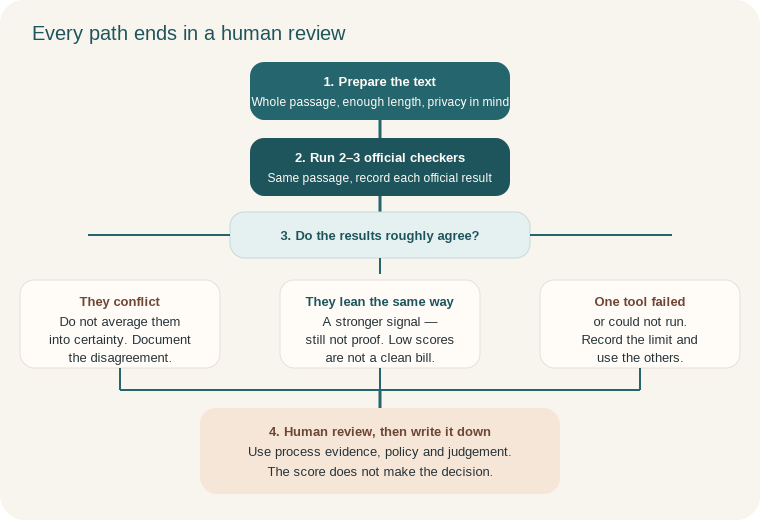
Start by preparing the text. Then run two or three official checkers on the same passage. Then ask only one comparison question: do the official results roughly agree, do they conflict, or could one tool not run?
If they conflict, do not average the numbers. Document the disagreement and go to human review. If they lean the same way, treat that as a stronger signal — including a cluster of low scores, which is still not a clean bill of health — and go to human review. If one tool failed or hit a published cap, record the limit, use the others, and go to human review.
The last box is always the same: a human review and a written record. Official sources cited here — QuillBot, GPTZero, Sapling, Turnitin, Jisc, OpenAI — all, in their own words, keep a person in that last box.
Frequently asked questions
Why doesn’t the flow end on “AI” or “human”?
Because official pages say a score is not a verdict. The flow ends on a person, a policy, and a record.
Sources checked for this page
- QuillBot official AI Detector page. Checked on 2026-11-18.
- GPTZero official homepage. Checked on 2026-11-18.
- Sapling official AI detector page. Checked on 2026-11-18.
- Turnitin, “Understanding false positives in Turnitin AI detection”. Checked on 2026-11-18.
- Jisc, “Principles for the use of AI in FE colleges”. Checked on 2026-11-18.
- OpenAI, “New AI classifier for indicating AI-written text” (31 January 2023; withdrawn 20 July 2023). Checked on 2026-11-18.
- Grammarly Support, “AI Detector user guide”. Checked on 2026-11-18.