Guide
A human review checklist
Main keyword: AI detection human review. This is an educational guide, not a hands-on test and not a paid ranking. Sources were checked on 2026-11-18 unless a citation says otherwise.
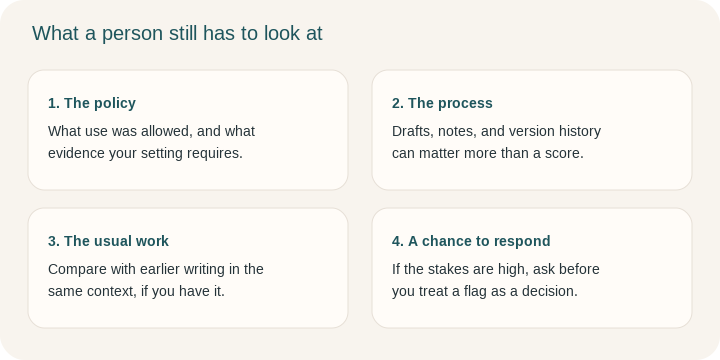
Why a person still has to look
Every official caution cited on this site points to a person. Turnitin’s official blog says the instructor must apply professional judgement, knowledge of the students, and the assignment’s context, because the false-positive rate is not zero. GPTZero’s official FAQ says results should start a conversation and should not be used to punish students, and it suggests asking for drafts, revision histories or brainstorming notes. Jisc’s official principles say detection “may have a part to play” but is “by no means a full solution,” and that learners should have a way to contest an AI system’s output when it affects their outcomes.
The University of Missouri’s official AI Detection Tools page records a Faculty Council opinion that AI detection software reports “should not be the sole evidence used for reporting students or misconduct proceedings.” That is one institution’s wording, not a global law. The idea travels well as a habit: do not let the printout be the only thing in the file. A printable version of this checklist is at /checklist.html.
The four looks
Policy. What AI use was allowed, and how should it have been disclosed? If the rule is unclear, that is part of the record, not a reason to treat a score as a substitute rule.
Process. Drafts, outlines, notes, and version history (for example in Google Docs) can show whether the work was built over time. GPTZero’s official FAQ, writing for educators, recommends looking at artifacts of the writing process and at a pattern rather than a single instance.
Usual work. If you have earlier writing from the same person in a similar context, compare it carefully and fairly. Turnitin’s official blog emphasises knowledge of the student and the assignment. A change in quality is a prompt for a conversation, not automatic proof of AI use — people also improve, struggle, or write in a second language.
A chance to respond. Turnitin’s official tips include assuming positive intent if evidence is unclear, and being open that a false positive may occur. Jisc’s contestability principle is the sector-level version of the same idea. In hiring or publishing, the same habit still applies: ask, and do not treat a score as a closed decision.
Then decide, and say what you used
A fair decision might be: no further action; a request for a rewrite or an in-person demonstration of understanding; a disclosure conversation; or, only if policy and other evidence support it, a formal process. Official sources cited here do not authorise a jump from “high score” to “guilt.” Write down which official checkers you ran, whether they agreed, and that the score was not used alone. See documenting a check.
Frequently asked questions
What if I have no drafts to look at?
Then say so in the record. Official guidance still asks for professional judgement and a chance to respond. A missing draft history is not the same thing as proof of AI use.
Can I skip human review when three tools agree?
No. Official pages still warn that tools can be wrong in both directions. Agreement is a stronger signal, not a finished decision.
Sources checked for this guide
- Turnitin, “Understanding false positives in Turnitin AI detection”. Checked on 2026-11-18.
- GPTZero official FAQ. Checked on 2026-11-18.
- Jisc, “Principles for the use of AI in FE colleges”. Checked on 2026-11-18.
- University of Missouri, “AI Detection Tools” (AI @ Mizzou). Checked on 2026-11-18.
- QuillBot official AI Detector page. Checked on 2026-11-18.
Related guides
- Documenting a check — A short written record keeps a check fair and honest: what you ran, what the official sites said, and that a score was not used alone.
- Handling a possible false positive — If a flag may be wrong, keep the official results, look at process evidence, and give the writer a fair response path. A second checker is context, not a counter-proof.
- What to do with conflicting results — If official checkers disagree, slow down. If they agree, you still do not have proof. Document what each official site said.
All guides · All sources · How we review · Tools we point to