Signal
An official checker result that can inform a closer look, but does not prove how a text was written. QuillBot’s official page says scores are “signals, not verdicts.”
- QuillBot official AI Detector page. Checked on 2026-11-18.
Reference
Short, sourced definitions of terms used in the guides. These are educational explanations, not vendor marketing copy and not a claim that every detector uses the same method.
Main keyword: AI detection glossary. Definitions were checked against the cited pages on 2026-11-18.
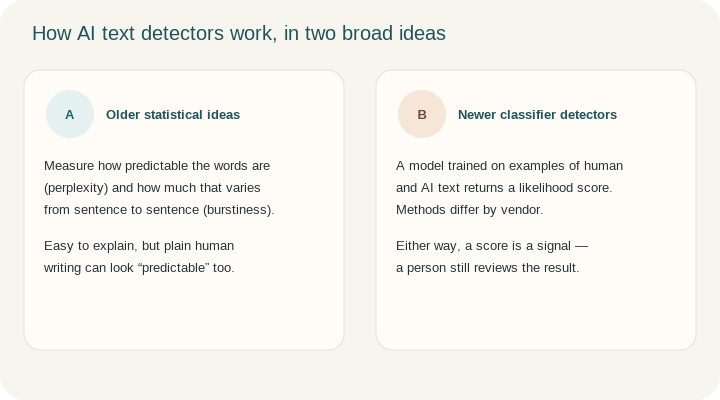
An official checker result that can inform a closer look, but does not prove how a text was written. QuillBot’s official page says scores are “signals, not verdicts.”
Using a detector as the only method for deciding whether text is AI-generated or human-written. Sapling’s official detector page says no current detector, including theirs, should be used that way.
Human-written text treated as AI-generated. Turnitin’s official blog uses that definition for fully human-written text and says the false-positive rate is not zero.
AI-written or AI-assisted text that a checker misses or treats as human. Official pages, including Sapling’s and OpenAI’s 2023 classifier page, say this error occurs and that edited AI text can be harder to detect.
Official checkers returning different scores or labels on the same passage. Grammarly’s official user guide says scores may differ from Turnitin, GPTZero, Copyleaks and others. This workflow says not to average them into certainty.
The step after official scores: policy, process evidence, usual work, and a chance to respond. Official Turnitin, GPTZero and Jisc wording all keep a person in the decision.
In Jisc’s official principles, the idea that if an AI system is used in a way that affects learner outcomes, including detection in assessment, people should have clear guidance on how to contest the output.
A figure published by a company about its own product, such as a 99% accuracy claim. This site may record the claim with a source and date; it is not a test we ran.
The text you have chosen and described before you paste it into official checkers: the relevant section, its length, and any AI editing tools already used, with official privacy rules in mind.
A short written account of the date, official URLs, official results in the vendor’s wording, human-review notes, and the decision, stating that scores were not used alone.
All guides · Sources · FAQ