Guide
Read the results as signals, not as proof
Main keyword: AI detector score meaning. This is an educational guide, not a hands-on test and not a paid ranking. Sources were checked on 2026-11-18 unless a citation says otherwise.
What official pages say the number is
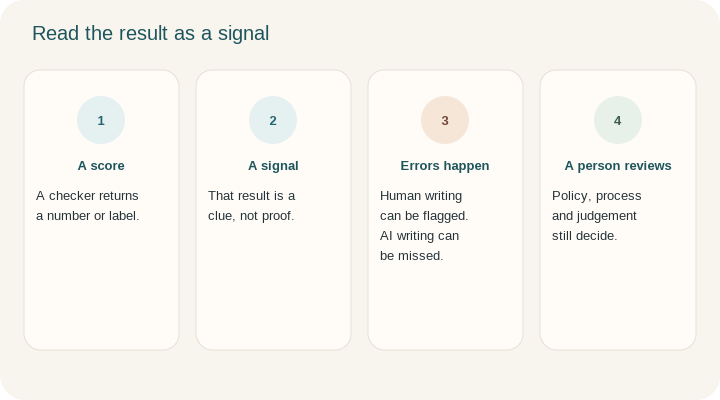
QuillBot’s official page says, plainly, “Scores are signals, not verdicts.” Grammarly’s official user guide says the percentage “should not be used as an objective source of truth,” that the feature “is not 100% accurate and should not be used as a definitive assessment,” and that the score “should be viewed as an average estimate rather than a definitive percentage assessment.” Scribbr’s official FAQ describes its score as a percentage indicating how much of the text contains content likely written or refined using AI tools, and adds that no model can guarantee 100% accuracy.
GPTZero’s official homepage says no detector is 100% accurate and that results should not be used to punish or as the final verdict. Sapling’s official detector page says no current detector, including theirs, should be used as a standalone check, and that false positives and false negatives will occur. Turnitin’s official blog says the company does not make a determination of misconduct and that the false-positive rate is not zero, so an instructor must apply professional judgement.
High advertised accuracy does not change that reading
You will see official marketing figures: ZeroGPT’s homepage figures, Pangram’s “1 in 10,000” false-positive claim, Copyleaks’ “99%” and “.03%,” Grammarly or QuillBot RAID claims, GPTZero’s “99.9%,” Turnitin’s “less than 1%” aim. When this site mentions those figures, it labels them as vendor claims. They are not our tests, and they sit on the same internet as the official warnings above.
OpenAI’s official page about its 2023 classifier is a historical reminder: the company reported 26% true positives and 9% false positives on a challenge set, then withdrew the tool for low accuracy, and wrote that it is impossible to reliably detect all AI-written text. That was one official evaluation of one official tool, not a score for every product in 2026, but it shows why a confident-looking percentage is still not proof.
How to write the result down
Quote the official wording: “62% likely AI-generated,” “mixed,” “human only,” or whatever the official page displayed. Add the date, the URL, and the length of the text. Then add your human-review note. Do not upgrade the vendor’s language from “likely” or “signal” into “proved.” The documenting guide is the worksheet for that.
Frequently asked questions
Does 0% mean no AI was used?
No official page cited here treats a low score as proof. Official sources also note that AI writing can be edited or missed.
Does a high score mean the writer cheated?
No. Official pages warn about false positives and say a score should not stand alone or be used to punish or to decide employment or academic standing on its own.
Sources checked for this guide
- QuillBot official AI Detector page. Checked on 2026-11-18.
- Grammarly Support, “AI Detector user guide”. Checked on 2026-11-18.
- Scribbr official AI Detector page. Checked on 2026-11-18.
- GPTZero official homepage. Checked on 2026-11-18.
- Sapling official AI detector page. Checked on 2026-11-18.
- Turnitin, “Understanding false positives in Turnitin AI detection”. Checked on 2026-11-18.
- OpenAI, “New AI classifier for indicating AI-written text” (31 January 2023; withdrawn 20 July 2023). Checked on 2026-11-18.
- ZeroGPT official homepage. Checked on 2026-11-18.
- Pangram official homepage. Checked on 2026-11-18.
- Copyleaks official AI Detector page. Checked on 2026-11-18.
Related guides
- What to do with conflicting results — If official checkers disagree, slow down. If they agree, you still do not have proof. Document what each official site said.
- A human review checklist — After the official scores, look at policy, drafts, usual work and a chance to respond. Then write down the decision.
- Handling a possible false positive — If a flag may be wrong, keep the official results, look at process evidence, and give the writer a fair response path. A second checker is context, not a counter-proof.
All guides · All sources · How we review · Tools we point to